Hastes de perfuração de peça única ou multisseção? Como escolher entre hastes de perfuração integrais e extensíveis?
The drill rod is the simplest component in the string — a length of alloy steel with threads at both ends. But the decision between buying it as one solid piece or as multiple connected sections changes how your crew works, how deep you can drill, and what your spare parts inventory looks like.
Integral rods and extension rods serve different drilling philosophies. Here's how to tell which one fits your operation.
Integral Rods: Simple, Tough, and Limited Only by Length
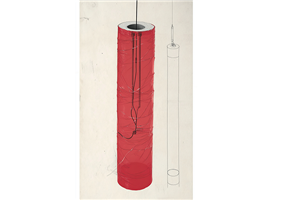
An integral drill rod is exactly what it sounds like: a single piece of forged and heat-treated alloy steel, threaded at each end, no joints in between. Lengths typically run from around 2,400mm up to about 4,900mm — R22, R25, R32, T38, and T45 thread profiles are common.
The appeal is straightforward. No coupling sleeves to stock, no connections to make up mid-hole, no chance of a joint working loose underground. One rod, one hole, done. The heat treatment runs the full length of the steel, so there's no weak point where two sections meet. For shallow drilling — roof bolting, short blast holes, development work where you're punching holes under four or five meters — an integral rod is often the cleanest solution.
The limitation is obvious: you can only drill as deep as the rod is long. If your hole depth changes across the site and you need to go deeper than your longest integral rod, you're switching to a different system. Integral rods also mean stocking multiple lengths, which adds inventory complexity if your depth requirements vary.
Extension Rods: Depth on Demand, at the Cost of Complexity
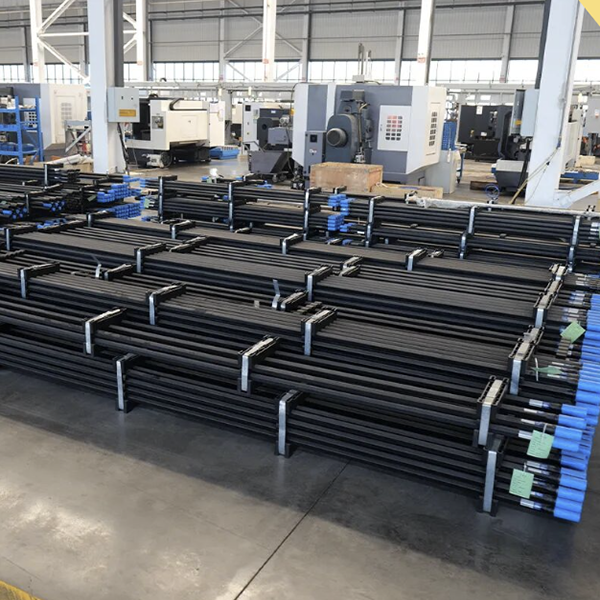
Extension rods — sometimes called sectional or combination rods — break the drill string into shorter segments connected by coupling sleeves. A typical setup might use a starter rod at the shank adapter end, then add extension sections as the hole deepens. Segment lengths range from as short as 800mm up to 4,200mm-plus, covering T38, T45, T51, and R32 threads. Round and hexagonal profiles are both available depending on the rig's rotation drive.
The advantage is flexibility. Need to drill a six-meter hole this morning and a fifteen-meter hole this afternoon? Same rod system, just add or remove sections. The coupling sleeves handle the torque and impact transfer between segments, and a well-designed connection won't meaningfully lose energy compared to an integral rod of the same total length.
The tradeoffs: each connection is a potential failure point, each coupling sleeve is a spare part you need to stock, and each rod change costs time. On a deep hole where you're running four or five sections, the make-up and break-out time per hole adds up. The connections also need to be kept clean and greased — skip that and the threads gall, the energy transfer degrades, and the rods fail early at the joints.
Making the Call
The decision comes down to three things: depth, consistency, and crew.
Se o seu furo típico tiver menos de cinco metros e as profundidades não variarem muito de turno para turno, as hastes integrais são imbatíveis. Menos estoque, menos pontos de falha, tempos de ciclo mais rápidos.
Se as profundidades variarem — ou se o furo padrão for maior do que uma única haste consegue suportar — as hastes de extensão são a solução. Invista em luvas de acoplamento de boa qualidade, treine sua equipe nos procedimentos corretos de montagem e mantenha as roscas limpas. O sistema funciona quando operado corretamente.
E certifique-se de que a haste seja compatível com a montagem. Uma haste integral muito longa para o movimento de alimentação ou uma haste extensível com o perfil de rosca errado para o adaptador de encaixe causarão problemas que não têm nada a ver com a qualidade da haste. Verifique a compatibilidade antes de comprar.